Published On: Dec 26, 2025
Last Updated: Oct 8, 2026
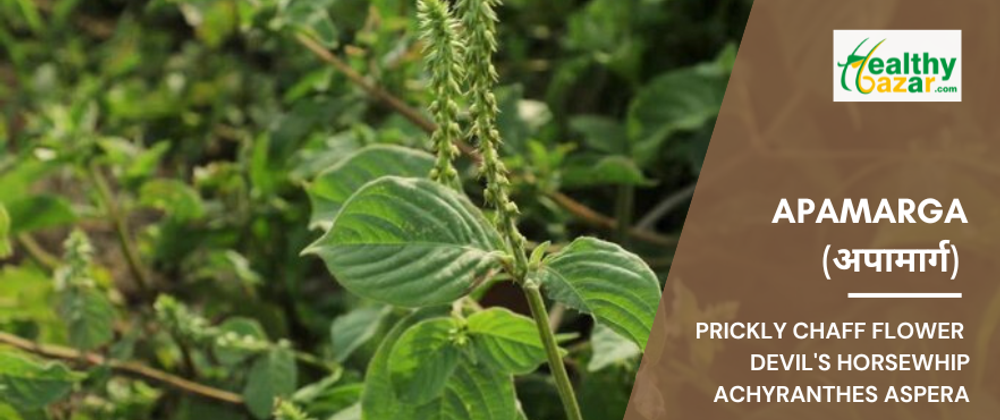
Apamarga, also known as Chirchita and botanically identified as Achyranthes aspera, is a widely distributed herb recognized in classical Ayurvedic texts for its potent action on digestive, urinary, and metabolic disorders. The plant is categorized under “Kshara Dravya’’ due to its ability to produce alkaline extracts used in specialized therapeutic procedures.
In Unani medicine, Apamarga is acknowledged for its desiccative (Mujaffif), resolvent (Muhallil), and diuretic actions, utilized frequently in respiratory, urinary, and joint disorders.
Modern scientific investigations identify Apamarga as a pharmacologically active plant containing saponins, alkaloids, flavonoids, ecdysteroids, and glycosides responsible for its anti-inflammatory, antimicrobial, antihyperlipidemic, and antihypertensive properties [1][2].
Morphology – Habitat and Plant Morphology
Ayurvedic Perspective:
Apamarga is described as an erect or suberect perennial herb, commonly found along roadsides, wastelands, and dry regions. It is easily recognizable by its rough texture, opposite leaves, and small greenish flowers arranged in long spikes.
Unani Perspective:
Classical Unani texts describe it as a coarse herb possessing desiccant qualities. The seeds and roots are noted for their medicinal potential.
Modern Scientific Description:
Achyranthes aspera is a stiff, woody herb, 1–2 meters tall. Leaves are simple, ovate, and pubescent. Flowers are small, in dense axillary or terminal spikes, and fruits are utricles containing single seeds. The plant thrives in tropical and subtropical climates and is distributed throughout Asia, Africa, and Australia [3].
Source, Part Used & General Dose
Source: Wild-growing herb found in dry and semi-arid regions.
Parts Used: Root, seeds, whole plant, leaves, and alkali (Apamarga Kshara).
Dose:
- Powder (Churna): 1–3 g
- Kshara: 250–500 mg
- Decoction: 20–50 ml
- Root extract: As per standardized preparation
Doses vary depending on indication and formulation [4].
Properties of the Herb
Ayurveda:
- Rasa: Katu (pungent), Tikta (bitter)
- Guna: Laghu (light), Ruksha (dry)
- Virya: Ushna (hot)
- Vipaka: Katu
Dosha Effect: Balances Kapha and Vata
Unani:
Mizaj: Haar Yabis (hot and dry)
Demonstrates desiccant, resolvent, diuretic, and expulsive actions.
Modern Science:
Phytochemical studies reveal saponins, oleanolic acid, achyranthine, ecdysterone, and alkaloids contributing to antimicrobial, anti-inflammatory, anti-obesity, and cardioprotective effects [1][5].
Benefits According to Health Concern, Method of Use & Dose
1. Digestive Disorders
- Ayurveda: Useful in indigestion, colic, and removal of Ama; Apamarga Kshara is included in Kshara Karma procedures.
- Unani: Acts as a carminative and reduces abdominal bloating.
- Modern: Shows antimicrobial properties beneficial in gastrointestinal infections [6].
Usage:
Churna 1–2 g with warm water.
2. Urinary Disorders
- Ayurveda: Beneficial in Mutrakricchra (dysuria), kidney stones, and as a diuretic.
- Unani: Used to relieve urinary retention and inflammation.
- Modern: Exhibits diuretic effects and may help reduce urinary tract pathogens [7].
Usage:
Decoction 20–40 ml twice daily.
3. Respiratory Conditions
- Traditionally used in cough, asthma, and phlegm congestion due to its Kapha-reducing nature.
- Anti-inflammatory action helps reduce airway irritation.
4. Metabolic & Lipid Disorders
Studies show antihyperlipidemic and anti-obesity potential due to saponin-rich extracts [5][8].
5. Wound Healing & Anti-inflammatory Activity
- Topical applications help reduce inflammation and microbial load.
- Modern studies confirm faster epithelialization and wound contraction [9].
Additional Benefits
- Anti-hypertensive effects
- Potential anti-fertility effects (studied experimentally)
- Antioxidant activity
- Analgesic effects
Forms of Herb & Dosages
- Powder: 1–3 g/day
- Kshara (alkali): 250–500 mg/day
- Decoction: 20–50 ml
- Tablets/Capsules: As per standardized extracts
- Paste (for topical use)
Product Formulation
- Ayurveda: Apamarga Kshara, Apamarga Taila, Apamargadi Churna
- Unani: Safoof formulations, diuretic syrups
- Modern Herbal: Ethanolic extracts in capsules, topical wound-healing preparations
Risk Factors / Precautions
- Avoid in individuals with gastric irritation due to hot potency.
- Excess use of Kshara may cause mucosal irritation.
- Not advisable during pregnancy due to uterine-stimulating properties reported in preclinical studies.
Side Effects
- Gastrointestinal irritation (high doses).
- Burning sensation or dryness.
- Possible interactions with antihypertensive medications.
Conclusion
Apamarga is a potent medicinal herb with well-documented benefits in digestive, urinary, respiratory, and metabolic disorders. Its therapeutic value is recognized in Ayurveda and Unani systems, and supported by emerging pharmacological research. When used within prescribed doses, it remains safe and effective.
FAQs
Q1. Can Apamarga be used for urinary stones?
- Ayurveda: Yes, traditionally used due to its diuretic and stone-breaking (Ashmari-hara) properties.
- Unani: Recommended in formulas relieving urinary obstruction.
- Modern: Animal studies suggest diuretic and antiurolithiatic potential.
Q2. Is Apamarga safe for long-term use?
- Ayurveda: Safe in mild doses; avoid long-term intake of Kshara.
- Unani: Should be used under supervision due to its hot and dry nature.
- Modern: Long-term safety data is limited; chronic high doses not recommended.
Q3. Can Apamarga be used for weight management?
- Ayurveda: Beneficial for Kapha-dominant obesity due to its drying quality.
- Unani: Helps reduce accumulated moistness and phlegm.
- Modern: Studies show lipid-lowering and anti-obesity effects of extracts.
Q4. Does Apamarga help in cough?
- Ayurveda: Yes, reduces Kapha and helps expectoration.
- Unani: Used as resolvent of thick phlegm.
Bibliography
- Singh B, et al. “Phytochemical and pharmacological profile of Achyranthes aspera.” J Ethnopharmacol. 2011.
https://pubmed.ncbi.nlm.nih.gov/21256168/
Reviews the plant’s active compounds and biological activities. - Sharma PV. “Dravyaguna Vijnana.” Chaukhambha Publications.
Classical reference describing Ayurvedic properties of Apamarga. - Udayan PS, et al. “Botanical description of Achyranthes species.” Indian J Nat Prod Resour. 2010.
https://nopr.niscpr.res.in/handle/123456789/10204
Provides detailed morphology and taxonomy. - Ayurvedic Formulary of India. Ministry of AYUSH. Official dosage and formulation guidelines.
- Yadav N, et al. “Antihyperlipidemic effect of Achyranthes aspera extract.” Indian J Exp Biol. 2017.
https://pubmed.ncbi.nlm.nih.gov/28970316/
Reports lipid-lowering activity. - Zhong L, et al. “Antimicrobial activity of Achyranthes aspera.” Pharmacogn Mag. 2015.
https://www.ncbi.nlm.nih.gov/pmc/articles/PMC4415834/
Demonstrates antimicrobial properties. - Kaliappan G, et al. “Diuretic potential of Achyranthes aspera.” Asian Pac J Trop Med. 2011.
https://pubmed.ncbi.nlm.nih.gov/21771503/
Shows diuretic and urinary benefits. - Rao S, et al. “Anti-obesity effects of Achyranthes aspera.” J Pharm Bioall Sci. 2016.
https://www.ncbi.nlm.nih.gov/pmc/articles/PMC5085146/
Demonstrates weight-reducing properties. - Kandhare A, et al. “Wound healing activity of Achyranthes aspera extract.” J Ayurveda Integr Med. 2016.
https://www.ncbi.nlm.nih.gov/pmc/articles/PMC5478299/
Explores wound-healing efficacy.
 Where should we deliver your order?


 5
5