Where should we deliver your order?


Ayurvedic
8 Yrs of Exp.
Top Rated
 5
5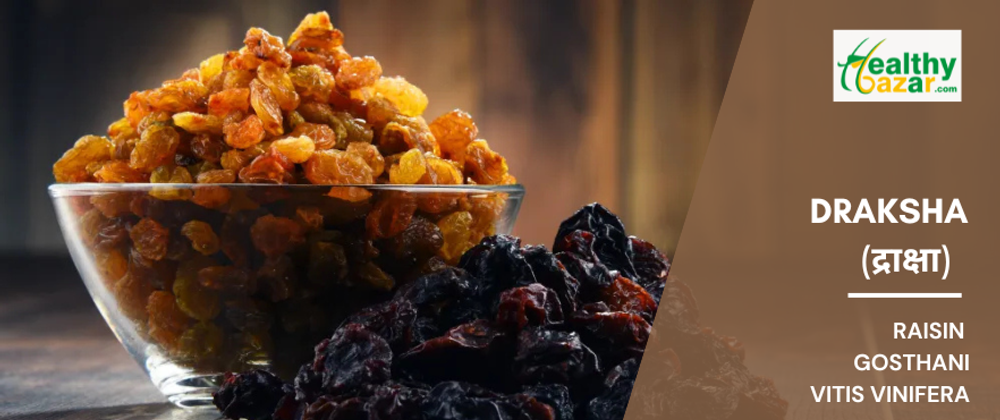
Draksha, commonly known as grapes (Vitis vinifera), is one of the most ancient cultivated fruits, valued across medical traditions for its nourishing, cooling, and restorative qualities. In Ayurveda, Draksha is classified as a Rasayana — a rejuvenating substance that supports strength, immunity, and digestive wellness. Its sweet taste and cooling nature make it suitable for individuals with excess Pitta or dehydration due to illness.
In Unani medicine, grapes are considered “Murattib” (moistening) and “Mulaṭṭif” (softening), used to correct dryness, constipation, and heat disorders. Modern science supports many of these classical uses, noting the antioxidant-rich profile of grapes, especially resveratrol, which supports cardiovascular health, anti-inflammatory pathways, and cellular protection [1][2].
Ayurvedic Perspective:
Draksha is described as a climbing vine with woody stems, broad lobed leaves, and clusters of soft, juicy fruits. Ayurveda highlights the fruit pulp, which is naturally sweet, cooling, and hydrating — making it ideal for patients experiencing fatigue, digestive distress, or heat-related disorders.
Unani Perspective:
Unani physicians describe the grapevine as a temperate plant producing berries categorized into “Matai’’ (sweet, moistening fruits). The fresh fruit, seed, and dried fruit (munakka) are all used therapeutically.
Vitis vinifera is cultivated worldwide, especially in Mediterranean and subtropical climates. The plant has tendril-bearing vines, large leaves, and berries that vary in color and phytochemical composition. Grapes contain polyphenols such as resveratrol, quercetin, catechins, and anthocyanins — compounds central to their therapeutic profile [3][4].
General Dose:
These doses are well-tolerated in most individuals [5].
Ayurveda:
Dosha Effect: Pacifies Vata and Pitta
Unani:
Modern Science:
Rich in vitamins (A, C, K), minerals, flavonoids, phenolic acids, resveratrol, and fiber. Exhibits strong antioxidant, anti-inflammatory, cardioprotective, and hepatoprotective effects [1][3].
1. Digestive Health
How to Use:
2. Liver Health
3. Heart & Metabolic Health
4. Respiratory Health
5. Fatigue & Weakness
Additional Benefits
Draksha/Angoor is a gentle yet profoundly rejuvenating fruit across Ayurveda, Unani, and modern science. Its cooling, antioxidant-rich nature supports digestion, liver health, cardiovascular function, and overall vitality. When taken in appropriate amounts, Draksha remains one of the safest and most nourishing natural remedies.
Q1. Can Draksha be given to children?
Q2. Is Draksha safe for diabetics?
Q3. Can grapes improve liver health?
Q4. Which is better — grapes or munakka?
Li X, et al. “Polyphenols in grapes and their health benefits.” Nutrients. 2016;8(7):E386.
https://www.ncbi.nlm.nih.gov/pmc/articles/PMC4963874/
Comprehensive review detailing antioxidant compounds in grapes and their role in disease prevention.
Tomé-Carneiro J, et al. “Resveratrol in primary and secondary prevention of cardiovascular disease.” Ann N Y Acad Sci. 2013;1290:37–51.
https://www.ncbi.nlm.nih.gov/pmc/articles/PMC3739369/
Explains cardioprotective effects of resveratrol and grape-derived polyphenols.
Georgiev V, et al. “Grape-derived polyphenols and their benefits.” Biotechnol Biotechnol Equip. 2014;28(4):581–591.
https://www.ncbi.nlm.nih.gov/pmc/articles/PMC6279079/
Discusses phytochemistry and environmental factors affecting grape medicinal value.
Nassiri-Asl M, Hosseinzadeh H. “Review of resveratrol and its antioxidant properties.” J Pharm Pharmacol. 2009;61(1):41–48.
https://pubmed.ncbi.nlm.nih.gov/19178772/
Explores antioxidant and protective activities of resveratrol.
Kaur M, et al. “Nutritional and therapeutic properties of grapes.” J Food Sci Technol. 2020;57(4):1207–1215.
https://www.ncbi.nlm.nih.gov/pmc/articles/PMC7172000/
Explores nutrient profile and therapeutic uses of grape fruit and extracts.
Uesugi D, et al. “Grape consumption and digestive health.” Nutrients. 2019;11(12):3003.
https://www.ncbi.nlm.nih.gov/pmc/articles/PMC6950539/
Investigates grape fiber and polyphenols on digestive function.
Guo C, et al. “Grape seed extract prevents liver injury.” Food Chem Toxicol. 2007;45(11):2281–2290.
https://pubmed.ncbi.nlm.nih.gov/17693054/
Animal study showcasing hepatoprotective actions of grape seed extract.
Kim M, et al. “Grape seed extract interactions with anticoagulants.” Clin Pharmacol Ther. 2010;87(3):315–321.
https://pubmed.ncbi.nlm.nih.gov/20075116/
Details potential herb–drug interactions with grape seed extract.



 5
5 4
4